• The Bureau of Labor Statistics is getting back on track with their monthly jobs reports after the government shutdown ended in November. Unfortunately, the labor market data is not allowing them to deliver good news in time for Christmas this year.

    Today’s data release estimates an unemployment rate of 4.6%, up from 4% at the beginning of 2025 (see figure below). The BLS report notes that the unemployment rate “changed little” from September, but these “little changes” are adding up and now it is becoming meaningful.

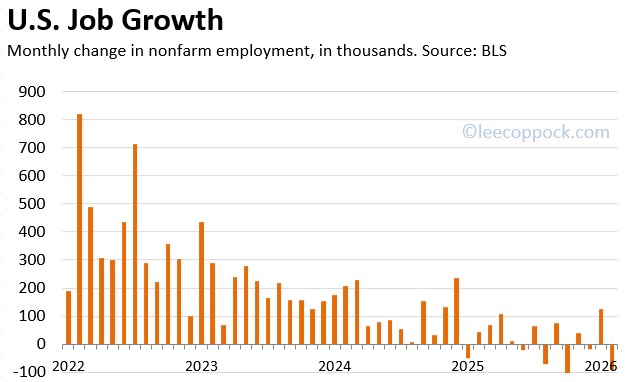
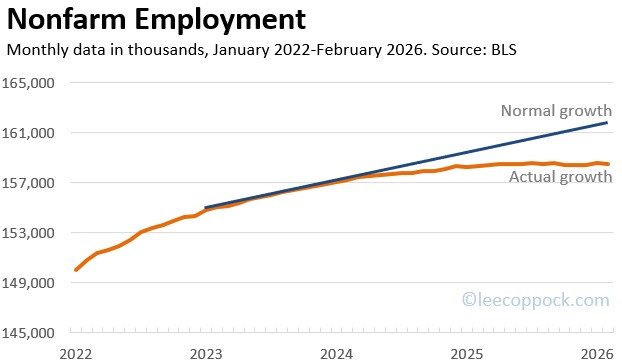
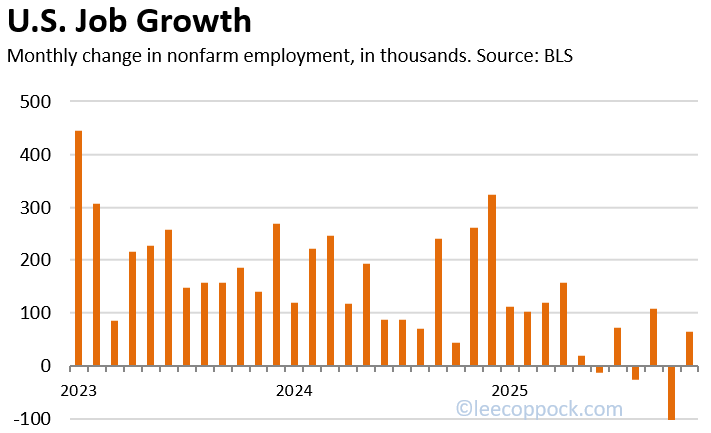
    Part of the reason the unemployment rate is rising is that overall jobs growth has slowed considerably. The U.S. economy generally adds about 200,000 jobs in a normal healthy month. But Since April of this year, jobs growth has been essentially flat. Today’s report estimates that 64,000 jobs were added in November, but this comes on the heels of new estimates that there was a substantial decline in October, with total nonfarm employment falling by 105,000 jobs. The Figure below shows monthly changes in nonfarm U.S. employment over the past three years. Notice the overall decline in 2025, especially since April.

    This new data indicates the U.S. economy is probably teetering on the edge of a recession. Going onto 2026, it will be important to see a bounce back in jobs growth and no more increases in the unemployment rate.

  • I just came across a cool new paper in which the authors analyze the color palettes of paintings to learn more about the economic growth when the paintings were created. They can actually see strong correlations between economic growth and paint colors. But even more, they use color data to uncover more about actual economic growth in periods where data is is sketchy or incomplete. Wow, this is a cool paper. The title is Colors of Growth, and it is written by four economists: Lars Boener, Tim Reinicke, Samad Sarferaz, and Battista Severgnini.

    They look at European paintings from 1600 to 1820 and they see significant variation in colors used. One reason is that certain colors are easy to attain even when an economy is poor (apparently red is widely available in nature), but other colors are hard to get (apparently a popular shade of blue required lapis lazuli from Afghanistan). In addition, the availability of indoor light comes along with economic growth. Thus, paintings that feature lighter colors indoors help to shown when a population is getting wealthier.

    For example, Figure 4 from the paper (shown below) shows a 20-year moving average of different colors in from British oil paintings. Notice the significant increase in the lighter shades just after the middle of the 17th century. That period corresponds with a period of significant British productivity growth. But then, several political and economic crises led to a growth slowdown at the end of the 17th century and this is also reflected in the paint colors.

    But the authors go on to use their model to actually uncover new evidence of growth and stagnation “that deviate from existing GDP estimates” for Germany and France. Their new color-based evidence is consistent with historical narratives of the period. This raises the possibility that the color analysis can help us find problems with historical economic data. Amazing.

  • Driving across southern Spain recently I was caught off guard by the sheer number of olive groves all over the Spanish mountains. It is much like driving through cornfields in midwestern USA. But these olive trees are built different: they grow all over the sides of rocky mountains and in arid conditions. If you visit Spain, you will be similarly impressed because about 5% of all the land in Spain is used for olive production.

    My wife suggested that we take a tour of an olive farm/factory and this did not disappoint!

    Olive groves in Spain occupy about 5% of the total land area.

    As it turns out, Spain produces about half of all the olives in the world. Pretty impressive. Some of these are eaten as table olives, but more than 90% are used for olive oil. These Spaniards take their olive oil seriously and we are the beneficiaries of this in the USA.

    What is the opportunity cost of olives in Spain? Well Spain is actually a very diverse economy, with total 2024 GDP of almost $2 trillion, which ranks 12th in the world. However, grapes are another land-intensive crop in Spain, occupying about 2% of all Spanish land. Side note: there is at least one student in my macro class this spring whose family owns a vineyard in Spain!

    Vineyards in Spain occupy about 2% of the country’s land area.

    Thus, in Spain, wine is an opportunity cost of olive production, and olives are an opportunity cost of wine. For simplicity, picture a production possibilities frontier (PPF) with olives on the x-axis and wine on the y-axis. The PPF has its normal downward-sloping shape indicating that more olive production means less wine production (and vice versa).

    I did not expect to be so excited about visiting an olive farm, but here we are. Below are two photos I took during my visit. the first shows me happily invading the personal space of some olive trees. The second shows some older Spanish gentlemen at the end of the production line with their fresh olive oil. They look very serious in the photo, but don’t let that fool you – they were even happier than I was.

    Up close and personal with some olive trees in southern Spain.
    Group of older Spanish men working in an olive oil production facility, filling bottles with olive oil and preparing for packaging.
    Don’t let these guys fool you – they were so happy to press their own olives at this olive oil factory.
  • The latest Consumer Price Index data release from the Bureau of Labor Statistics shows prices rose 0.3% in September, putting the 12-month inflation rate at 3.0% — roughly flat compared to August’s 2.9%. In other words, inflation’s not racing downhill anymore, but it’s also not climbing like it did in 2022. Gasoline once again stole the spotlight, jumping 4.1% in a single month, helped along by higher energy commodities and travel costs. Meanwhile, food prices calmed a little, with grocery prices edging up just 0.3%. Shelter inflation also eased slightly, with the rent and owners’ equivalent rent measures growing at their slowest pace since early 2021 — a sign that housing costs might finally be getting the memo.

    Zooming out, the 3.0% annual inflation rate represents a return to something close to normal, though still above the Federal Reserve’s long-term 2% target. After peaking at over 9% in mid-2022, annual CPI has steadily cooled — but energy and housing remain the two stubborn holdouts, occasionally re-inflating like a bad group project that just won’t end. The big picture? Prices are still rising, just not fast enough to set off alarms — unless, of course, you’re filling your tank, buying airline tickets, or grading an econ midterm about “transitory inflation.”

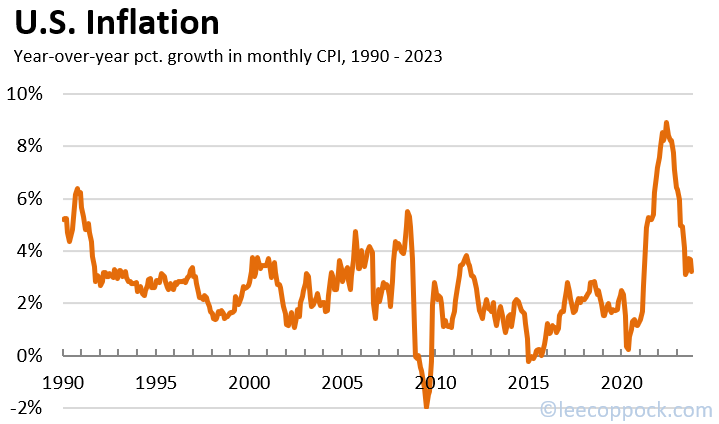
  • Data released by the BLS this week shows that the rate of CPI inflation in the U.S. was just 3.2% in October.  The graph below shows annual inflation rates since 1990.

    Inf 1123

    This is monthly data, but it shows the percentage growth in the CPI over the course of one year. This is how we generally measure inflation, but drastic shifts in this inflation measure are rare because it includes data for the entire preceding year.  In fact, looking at the raw CPI data for October 2023 indicates no change at all for the CPI (zero inflation) for the month of October.

    I like to point out that the battle to reduce inflation has been admirably fought by Jerome Powell and the Federal Reserve.  They have weathered many complaints about potentially rising unemployment over the past year and a half as they tightened monetary policy through interest rate rises.  And yet the unemployment rate in the U.S. is still just 3.9 percent.  

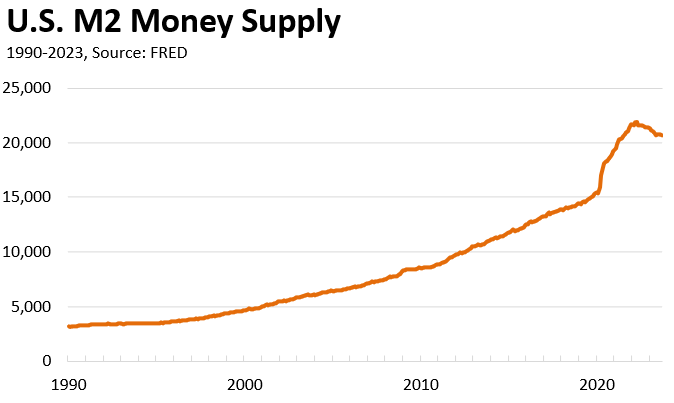
    The Fed's increases in interest rates have reduced the quantity of money circulating in the economy.  The graph below shows the M2 money supply since 1990. 

    M2 1123

    Economists do not all agree on the direct link between M2 and inflation, but they are clearly not unrelated.  That is, many factors might influence inflation in the economy, but the M2 money supply is a clear contributor.

  • On the heels of a great GDP report last week, the jobs numbers released today by the BLS are disappointing.  The good news is that 150,ooo new jobs were added to nonfarm employment. However, since 2020, we have gotten used to much larger increases in employment. For example, in the 12 preceding months, the economy added an average of 258,000 jobs per month.  The graph below shows growth in U.S. nonfarm employment since 2021.  Clearly, the increases are slowing since days just after COVID-19.

    Employ1123

    In addition, the unemployment rate ticked up to 3.9% in October (from 3.8% in September) and the labor force participation rate edged down to 62.7 % (from 62.8%).  Taken together, this is just not a strong jobs report.

    The October numbers may be lower because the survey was taken during major work stoppages — notably the strikes by the United Automobile Workers and related layoffs. Since then, the U.A.W has informed the workers who were on strike to return to their jobs. The union has reached tentative contract agreements with the three major U.S. auto companies.

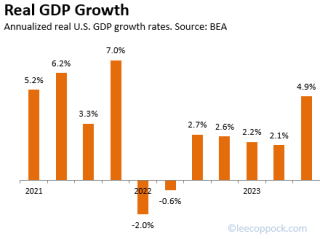
  • New data released by the BEA yesterday indicates that the U.S. economy is growing at a rapid clip. The first (advance) estimate of real GDP growth in the third quarter of 2023 is 4.9 percent. The graphic below shows quarterly real GDP growth since the beginning of 2021. The growth estimate for our most recent quarter is the strongest in nearly two years!

    GDP2023III

    If we take the GDP growth along with low unemployment rates (3.8% in September), it is clear that the U.S. economy is not struggling right now. 

    Yes, there are some troubling issues on the horizon, like higher consumer debt, high and rising federal budget deficits, and relatively high interest rates.  However, the Federal Reserve has reduced inflation rates significantly over the past 18 months and the the economy still chugs along. 


  • Total nonfarm employment grew by 336,000 jobs in September, according to the latest jobs report from the Bureau of Labor Statistics.  The big jump in employment  held keep the unemployment rate near historic lows, at just 3.8 percent.  The graph below shows total nonfarm employment in the U.S. since the beginning of 2012.

    Employ1023

    The graph makes it clear the the U.S. economy is back at (or very near) the trend line from before COVID-19 hit the economy.

    This Wall Street Journal article includes a nice graphic (pasted below) that dissects the jobs growth into four major sectors: goods (manufacturing), government, leisure and hospitality, and other services.

    Tmp
    As the graphic makes clear, most U.S. jobs growth comes in service-sectors, rather than goods-producing.  Manufacturing gets a lot of attention in the media and from politicians, but service jobs are really driving U.S. employment.


  • New CPI data released today from the BLS indicates that U.S. inflation is not yet tamed. The graph below shows the one-year growth rate of the CPI on a monthly basis since the beginning of 2022.  

    Inf0913

    After consistent declines since June 2022, inflation has now increased slightly for two months in a row, and is now back up to 3.7 percent. This should worry anybody who hoped that inflation would continue falling down into the 2% range.

    As for particular categories, gasoline prices rose drastically in August, up 10.6% in just one month. Rental housing expenses are also up 7.3% since a year ago. This is particularly difficult for consumers, since about 35% of monthly spending is on housing for an average consumer.

    One word of caution: gas prices and housing costs do not cause inflation, they merely reflect inflation. Many other prices in the economy have fallen over the past year (for example, television prices are down 10.1% and washing machines are down 12.8%). Over time, when the overall price level rises (as opposed to changes in the relative prices of goods) it is due to changes in the overall quantity of money in an economy. The quantity of money is hard to measure, but the Federal Reserve does control a large chunk of it, and so monetary policy can definitely affect inflation rates.  This means that Jerome Powell's job is not yet done.

  • Today's CPI report indicates that lower inflation is probably here for a while. Year-over-year growth in the CPI was just 3.2% in July (see the graph below). This follows on the heals of 3.1% inflation last month.  You can see from the graph that inflation is now back down into its normal range.

    Inf 0723

    The lower inflation reflects the Federal Reserve's commitment to bring inflation down to the 2% target range.  Just one year ago, inflation was 8.4 percent.

    Keeping in mind that inflation is the growth rate of the general (overall) price level, it is still interesting to look at changes in some individual prices.  The table below shows a selected few "big movers," or prices that moved a lot in the past year. The last column also gives the weight assigned to these categories in the overall CPI.  Recall that this weight is equivalent to the portion of a typical consumer's monthly budget spent on these categories.

    CPI Table 0723

    As you can see, gasoline prices fell by almost 20% over the past year and the typical consumer spends about 3.4% of their monthly budget on gasoline. Frozen vegetable prices rose dramatically over the past year, climbing 17.1 percent.