• Half of the U.S. states have now decriminalized or legalized marijuana for medicinal or recreational uses.  However, as Serge Kovaleski reports in The New York Times, legal marijuana businesses in these states cannot open bank accounts to store their funds, or offer credit and debit card transactions.  So, for now, all transactions are in cash (currency).

    Banks are reluctant to open accounts for marijuana businesses because they fear federal government laws.  That's right: it's still a federal crime to sell, possess or use marijuana. 

    According to Kovaleski:

    The limitations have created unique burdens for legal marijuana business owners. They pay employees with envelopes of cash. They haul Chipotle and Nordstrom bags containing thousands of dollars in $10 and $20 bills to supermarkets to buy money orders. When they are able to open bank accounts — often under false pretenses — many have taken to storing money in Tupperware containers filled with air fresheners to mask the smell of marijuana.

    So what does this have to do with macroeconomics?  Currency held outside the banking system reduces the money multiplier and, all else equal, leads to a lower quantity of money in the economy. 

    Oh dear, will this cause another economic contraction? No.

    Kovaleski reports that the legal marijuana industry expects revenues of $3 billion this year. And, while that is a lot of cash, it is very, VERY small in comparison to the U.S. money supply, which is currently around $11 trillion (M2).  The money supply might fall (see chapter 17 in our macro text), but not by nearly enough to affect the overall economy.

  • Ben Bernanke is serving his last week as the Chair of the Federal Reserve and will be replaced by Janet Yellen on February 1st, which makes this a good time to consider his track record.

    I agree with Kevin Grier (aka Angus), who praises Bernanke for avoiding both financial catastrophe and inflation.  Ben considers the monetary authority to be limited in its ability to manage the macroeconomy.  He sees the Fed's power as limited to two functions:

    1. Controlling inflation
    2. Providing ample money in times of crisis

    The data shows that Bernanke was successful in both endeavors. 

    First, inflation averaged just 2.2% during Bernanke's tenure (see figure below), lower than any of his predecessors since the 1970s.  Ben is probably not unhappy with this result. 

    Inflationbernanke

    Second, Bernanke made sure there was plenty of liquidity in markets during the darkest days of the Great Recession and the recovery, even when this involved creating a new tool (quantitative easing) and figuring out how to use it, all without causing inflation.  Tough job.

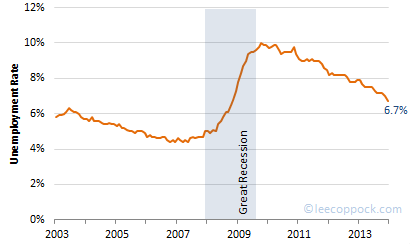
  • The jobs report released last Friday by the BLS reported a drop in the unemployment rate in December from 7% to 6.7%.  The decline is pictured below.
    Unemp1213

    Sounds like really great news, right?  After all, the unemployment rate hasn't been this low in five years!

    Still, here are the reactionary headlines in the financial news media:

    The financial media got this one right.  Overall, the jobs report brought very bad news.  To understand why, we need to dig a little deeper into the report and reiterate how the unemployment rate is calculated.

    First, let's look at another statistic: new jobs created.  Over the past four years, the U.S. economy has added about 130,000 jobs per month.  In December, the number was just 74,000 (see figure below).  This is particularly concerning in an economy that is still recovery from a tough recession.

    Newjobs1213

    Yet, even with slower jobs growth, why did the unemployment rate drop so much?  The answer offers a good lesson in how the unemployment rate is calculated.  The unemployment rate is the portion of the labor force that is unemployed.  But in December, the labor force contracted by 347,000.  This. Is. Bad. News. The primary reason the unemployment rate fell is because many people left the labor force, not because they got jobs. This decline in the labor force means that the labor force participation rate is down to 62.8% and hasn't been lower since 1977.

    So this is certainly not a positive economic report.  On the other hand, it is only one report and these numbers are difficult to estimate accurately every single month.  Let's hope this month looks significantly better.

    Summing up the December jobs report:

    1. The unemployment rate fell to 6.7%, the lowest level in 5 years, but…
    2. Nonfarm employment grew by just 74,000, well off the recent pace, and…
    3. Labor force dropped by 347,000, and this means…
    4. Labor force participation rate fell to 62.8%, the lowest level since 1977.

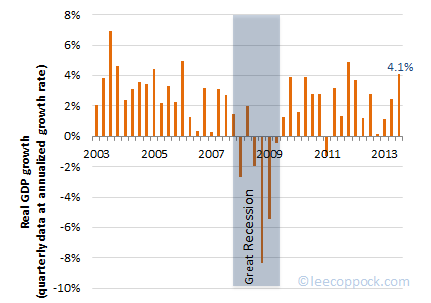
  • The third (and final) GDP estimate for the third quarter revised growth up yet again, this time to 4.1%.  This figure indicates that growth was stronger in the third quarter than at any time since the end of 2011. The graph below shows quarterly growth rates since 2003.
    GPD2013.IIIc
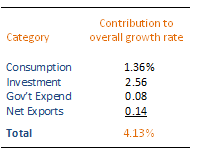
    Notice that 4.1% is larger than all but one quarter since before the Great Recession.  These are the kinds of growth rates we need if the economy is to truly recover from the Great Recession.  Finally, the revisions indicate that more of the growth came from consumption than previously thought.  The table below shows how each of the four categories of GDP spending contributed to overall growth. GDPTable2013.III

    The takeaway:

    1. GDP growth in the third quarter was higher than all but one quarter since 2006.
    2. The new data shows greater growth in consumption.
  • The latest jobs report shows the unemployment rate dropped to 7.0% in November, the lowest level in five years.  In addition, the economy added 203,000 more jobs.

    Unemp1113

    The last time the unemployment rate was this low was in the worst period of the Great Recession.  During the fourth quarter of 2008, the unemployment rate climbed from 6.1% to 7.3%, on its way to 10% by the end of 2009.  During 2009's bleak fourth quarter, real GDP contracted by more than 8%. 

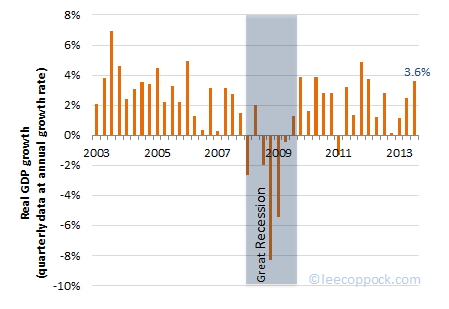
  • This week's GDP report, the second GDP estimate for the 2013 third quarter, brings good news, though perhaps not as good as it seems.  The report revised the growth rate up to 3.6% (the first estimate was 2.8%).  Quarterly growth data since 2003 is graphed below.

    GDP2013-3b
    There is nothing wrong with 3.6%.  After all, that is the best single quarter since the end of 2011.  On the other hand, the big growth came to business inventories which contributed almost half of the GDP growth of the period (1.68 of the 3.6%). 

    Here is the breakdown of the contributions from the four major components of GDP:

    • Consumption: +0.96%
    • Investment: +2.49%
    • Government: +0.09%
    • Net Exports: +0.07%

    Remember that private inventory is part of investment.


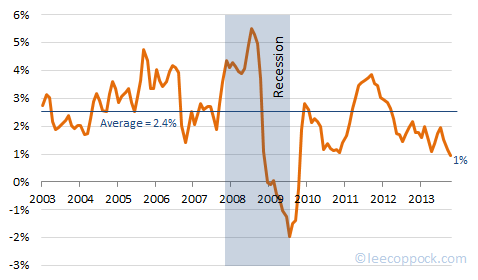
  • The CPI report for October shows that inflation remains at historically low levels.  Overall, the CPI actually declined in October by 0.1%, pushed down by a 2.9% decrease in gas prices.

    The graph below shows year over year changes in the CPI since 2003.  The average annual inflation over this period was 2.4% but, in the most recent year, prices increased by just under 1%.

    Inflation1013

    For a longer historical perspective, consider that inflation rates since 1960 averaged 4%.

    The latest CPI report also reveals the presence of larger swings in some specific consumer categories. Here are a few of these, all of which are seasonally adjusted:

    • Frozen fish and seafood prices up 2.4% in October; up 5.9% in year
    • Lettuce price up 4% in October and 10.3% in year
    • Men's pants and shorts prices up 10.3% in October alone
    • Gasoline down 2.9% in October and 10.1% in year

    What the heck is going on with the price of men's pants?


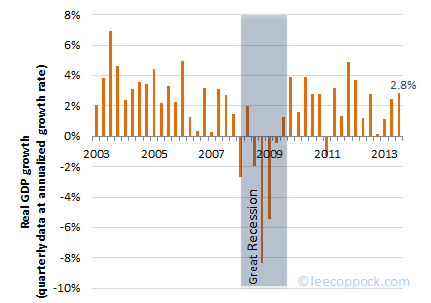
  • Real GDP grew at 2.8% in the third quarter of 2013, according to the advance estimate released today by the BEA.  This growth rate is very close to the long-run average growth rate for U.S. real GDP, which is 3%.  The graphic below plots quarterly GDP growth rates since 2003.

    GPD2013.III

    If this number holds up, it is the strongest growth the U.S. economy has had since the first quarter of 2012.  Keep in mind, this is the first estimate (also known as the advance estimate), and will be revised twice over the next two months. 


  • The unemployment rate edged up slightly in October, but nonfarm employment rose by 204,000, according to the jobs report issued today by the BLS. The unemployment rate (pictured below) edged up from 7.2% in September.

    Unemp1013

    The news isn't all bad as nonfarm employment growth was higher than it has been for all but two months in 2013.  The change in nonfarm employment is pictured below.

    Employ1013

    For those of us that are concerned about the labor force participation rate, this latest report does not bring good news, as the LFPR fell to just 62.8%.  However, some of this drop is due to some workers that were not working during the government shutdown.

    Summary:

    1. Unemployment rate rises to 7.3%
    2. Nonfarm employment grew by 204,000
    3. LFPR continued its decline, dropping to just 62.8%

    Hopefully the jobs growth can continue for a few months and can bring the unemployment rate down below 7%.


  • The September jobs report shows a slight decline in the unemployment rate for September, as the rate fell to 7.2%.  Over the past year, it has fallen by 0.6%, as it was 7.8% in September of 2012.  The graph below shows the unemployment rate since the beginning of 2003.

    Unemp913

    Other important statistics from this report:

    • Nonfarm employment rose by just 148,000 jobs.  This is not enough to bring the unemployment rate down to its natural level.
    • The labor force participation rate continued its decline, falling to just 63.2%.