• Today's Detroit News has a nice article on both the development and impact of the assembly line in car production. Henry Ford brought assembly line technology to the car industry in 1913.  Before the assembly line, cars were luxury items, affordable only for the very wealthy.  Ford's innovation reduced costs dramatically and allowed for cheaper car prices, which made them more affordable for the masses. 

    Ford was first to implement the line, allowing Ford Motor Co. to increase production of its Model T sevenfold and drop the price by nearly half — from $600 to $360 — during a five-year stretch from 1912 to 1916.

    The innovation propelled the auto industry and the American economy to new heights, and changed the way ordinary Americans lived their lives. 

    The assembly line is a great illustration of a technological advancement.  We often visualize new technology in terms of new goods (like the new Samsung Galaxy Gear).  However, the idea behind the item is the technological advancement.  New technology is a result of somebody arriving at a more efficient way of doing an old task.

  • Japan is simultaneously implementing both expansionary and contractionary fiscal policy.  According to The Wall Street Journal, the massive government debt has necessitated an increase in the national sales tax:

    Prime Minister Shinzo Abe took a long-awaited decision to raise Japan's sales tax by 3 percentage points (LC: up to 8% total), placing the need to cut the nation's towering debt ahead of any risk to recent economic growth…

    In order to offset this increase in taxes, Abe also promised an additional fiscal stimulus:

    The stimulus measures total around ¥5 trillion ($51 billion), including cash-handouts to low-income families, Mr. Abe said. On top of that, there will be tax breaks valued at ¥1 trillion for companies making capital investments and wage increases.

    Both of these policies are focused firmly on aggregate demand. 


  • One of my pet peeves is the myopic view that our most recent recession (the Great Recession) is comparable to the contractions of the 1930s (the Great Depression).  Photographs from the Depression era are very helpful in dispelling this misconception. 

    Today's Mail Online published a series of poignant Walker Evans photos from the 1930s, which illustrate the extent to which life in the Depression era was completely different from life in the past five years.

    I know the Great Recession was difficult for many and that long-term unemployment remains stubbornly high.  But let's not equate it to the Great Depression.  After all, according to this website, nearly 500 new Starbucks locations opened in the United States during the worst part of the Great Recession (between 2007 and 2009).


  • Today, the Fed announced that they will continue to buy $85 billion worth of securities per month "until the outlook for the labor market has improved substantially in the context of price stability."

    This is a change of plans for the Fed.  This summer, they announced that they had planned to taper (decrease) these purchases as the unemployment rate fell.  What changed their mind? Low inflation and high unemployment:

    Some indicators of labor market conditions have shown further improvement in recent months, but the unemployment rate remains elevated. Household spending and business fixed investment advanced, and the housing sector has been strengthening, but mortgage rates have risen further and fiscal policy is restraining economic growth. Apart from fluctuations due to changes in energy prices, inflation has been running below the Committee's longer-run objective, but longer-term inflation expectations have remained stable.

    So the taper is off, but tapirs are still on.

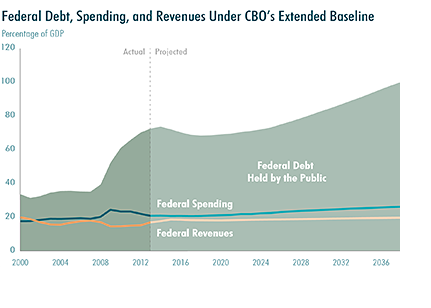
  • Today, the Congressional Budget Office (CBO) revised upward its estimates for future U.S. federal debt levels.  As the graph below shows, the CBO  projects the federal debt held by the public to reach 100% of GDP in 2038. 

    How bad is this news? Just last year, the CBO predicted that this debt measure would actually fall to just 53% by 2030.

    Cbo0913
    The reasons for this massive revision are summarized nicely by Peter Coy at Bloomberg Business Week.  In short, they include:

    1. New budget agreements from January, which made the Bush tax cuts permanent for many Americans
    2. Longer life expectancy estimates, which mean higher costs for both Social Security and Medicare
    3. A growing number of worker disability claims
    4. Higher unemployment forecasts, which means lower GDP and higher Debt-to-GDP ratio

    These factors work together to substantially worsen the long-term prospects of the U.S. national debt level.

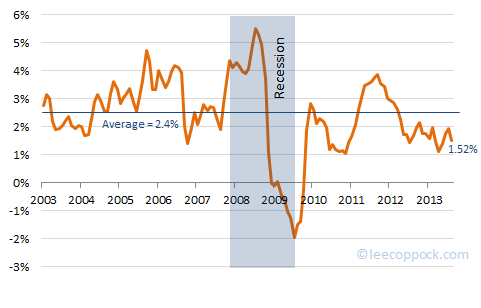
  • Consumer prices in the U.S. increased 1.52% for the year ending in August.  In the month of August alone, the increase was just 0.1%.  The graph below shows year over year increases in the Consumer Price Index (CPI) back to 2003.

    Inflation0813
    By historical standards, recent inflation rates are relatively low; over the past 50 years, inflation averaged about 4%. However, the average has been just 2.4% since 2003.

    Also, keep in mind that the CPI measures changes in the overall price level.  It is computed by looking at average prices of over 8,000 goods in 38 geographic locations.  Thus, even though prices increased 1.52% over the past year, some prices rose much more and some even fell. 

    Prices that rose significantly:

    • Fruits and vegetables: +3.6%
    • Tobacco and smoking products +3.2%
    • Hospital Services: +5.7%

    Prices that fell:

    • Used cars and trucks: -1.0%
    • Nonalcoholic beverages: -1.0%
    • Gasoline: -2.4%
  • The unemployment rate in Greece rose to 27.9% in June.  It is worst among young adults:

    Data showed those aged 15 to 24 remained the hardest-hit as the jobless rate in this age group, excluding students and military conscripts, registered 58.8 percent.

    The Greek economy is in its sixth year of recession.  That's going to leave a mark.


  • The Dow Jones Industrial Average (Dow) is changing its composition of stocks today, both adding and deleting some well-known U.S. firms.  The table below lists the changes to the Dow.

    Who's in:

    • Goldman Sachs
    • Nike
    • Visa

    Who's out:

    • Bank of America
    • Alcoa
    • Hewlett-Packard

    The goal of the Dow is to provide an indicator of conditions in the overall equity market by looking at just thirty representative stock prices.  Since they only use thirty companies and look strictly at average share prices, rather than the 500 equity-weghted stocks in the S&P 500, the Dow selection committee has to be very careful when choosing which stocks to include.

  • The labor force participation rate is the lowest that it has been since 1978. The graphic below shows how it has fallen since 2003.

    Lfpr0813
    Brad Plumer at the Washington Post offers three good reasons for this decline:

    1. America is aging; baby-boomers are now retiring.  Though this is certainly true, it, alone, is not enough to explain the entire decline.
    2. The bad economy is keeping workers in school and out of the labor force.  This story is bolstered by data that shows that the rate entry to the labor force is declining.  We know more young people are choosing college and this makes a difference.
    3. More workers are going on disability insurance.  According to Plumer, there are now twice as many workers on disability insurance (8.8 million) than there were in 1995.

    If you are interested in this topic, you should read Plumer's post – he presents both data graphics and research to support his arguments.

  • The New York Times reports that U.S. birth rates were flat in 2012, ending a decline that began in 2007.  The falling birth rate seems to be linked to economic conditions:

    In 2011, the Pew Research Center analyzed the fall in fertility by geography and found a strong link between falling fertility and economic malaise: the only state to show a slight increase in fertility between 2008 and 2009 was North Dakota, which had one of the lowest unemployment rates in the country.

    Hat tip: Tyler Cowen.