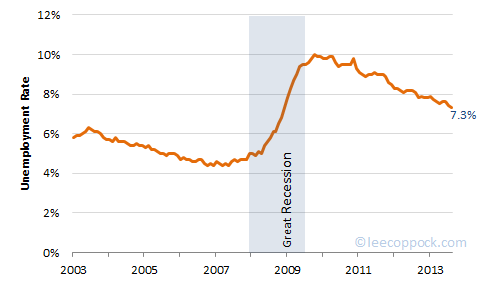
• This morning, the BLS released the jobs report for August.  The good news is that the unemployment rate dropped to 7.3%, the lowest level in the United States in almost five years (December 2008).

    Unemp813
    But, to be frank, the jobs report offers some other figures that indicate the economy is not growing robustly.

    First, consider employment growth, measured by gains in nonfarm employment.  Total nonfarm employment grew by 169,000 jobs in August (not bad).

    Employ0813
    The bad news is that downward revisions to data from the prior two months indicate that the economy is adding an average of just 148,000 jobs per month, which is not enough to significantly reduce the unemployment rate, especially with labor force participation rates at historically low levels.  And that brings us to the other piece of negative news…

    Lfpr0813
    The labor force participation rate fell to 63.2%, the lowest level in the U.S. since 1978.  This means that millions of Americans continue outside the labor force and the portion of Americans with jobs continues to shrink.


  • Today's GDP report from the BEA shows an estimated 2.5% growth of real GDP for the United States in the second quarter of 2013.  The earlier report from July estimated just 1.7% growth. 

      GPD2013.II

    While the new revision is welcome news, the current growth rate is not enough to return the economy to full health and lower the unemployment rate to its natural level.

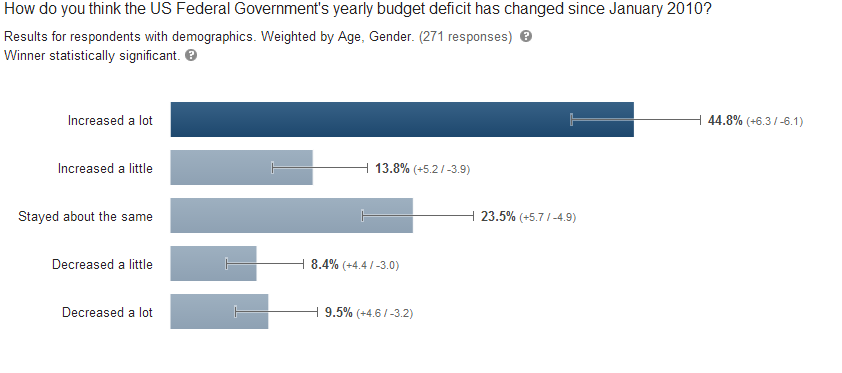
  • Kevin Drum at Mother Jones reports on the public perception regarding the deficit and points to a google poll to illustrate his point. The chart below shows the current results. 

    Deficit poll
    Why do most people believe the deficit is increasing when we know it has been shrinking since 2011?  Kevin suggests that this is because people are too slow to change their opinion. 

    I don't think that is the problem.  I think the problem is that people confuse deficits with the national debt, and the national debt is still growing because we actually still have large deficits.

    Hat tip: Megan McArdle.

  • The Daily Telegraph offers one of the most vivid illustrations of how institutions affect economic growth. It does this by showing photos of Shanghai in 1987 and in 2013.  The contrast is stunning.

    Start with the 2013 view of Shanghai, the financial center, or "New York City", of China.

    Now, compare it to the view in 1987.

    The difference?  Private property rights.  Institutions really do matter.

  • Today, the Bureau of Economic Analysis released the third and final GDP estimate for the first quarter of 2013.  The estimate of real GDP growth is 1.78%, which is positive. However, it is still well below the 3% historical average (based on the past 50 years).

    The first figure below shows the quarterly growth rates for real GDP since 2003.  Since the Great Recession, real GDP growth rates have been relatively low, especially considering the economy is technically in recovery mode.

    Graph1

    (more…)