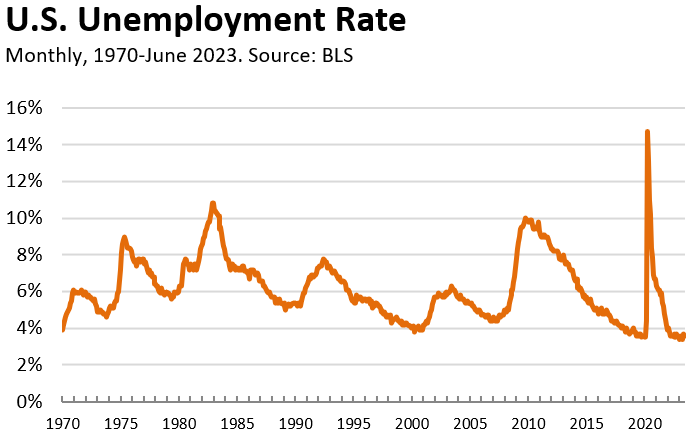
• Today's jobs report brings more strong data and very little change from the past few reports. The unemployment rate (pictured below) remains at historically low levels, falling to 3.5% in July, and jobs growth remains robust, with 187K new jobs added.

    Unemp0723

    On the other hand, the strong unemployment rate is probably overstating the overall health of the labor market.  As we have talked about previously, the labor force participation rate (LFPR) remains at low levels.  You can see in the figure below that the current level (62.6%) is still way below the pre-pandemic level, which was also very low relative to U.S. economic history. 

    Lfpr0723

    This low LFPR indicates that there are still millions of potential workers not in the labor force.

  • Today's jobs report brings some good news but also some sobering reality.  First the good: the unemployment rate remains near its fifty-year low, coming in at just 3.6% for June.  The graph below shows the U.S. unemployment rate. 

    Unemp 0623

    Part of the reason the unemployment rate is so low is that the labor force participation rate (LFPR) is still historically low. So unemployment is low but many potential workers are still "sitting on the sidelines," and not part of the labor force. The LFPR in June was just 62.6 percent.  While this is up from 62.2% a year ago, it is still way down from the 63.3% we saw prior to COVID-19.

    Now, the more sobering news. Nonfarm employment rose by 209,000 jobs in June. Ordinarily this would be seen as solid overall jobs growth, but it is the smallest increase in jobs since the end of 2020.  The graph below shows monthly changes in nonfarm employment since January 2021.  

    Nfe 0623

    In the period graphed above, there has been tremendous gains, but these gains seem to be slowing down over the past five months.  

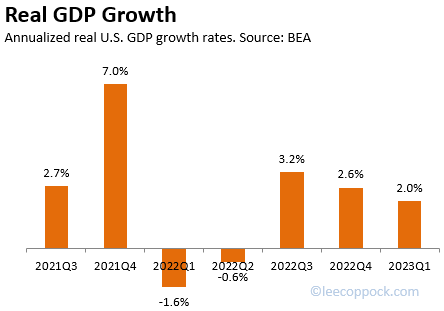
  • New data from the Bureau of Economic Analysis (BEA) today shows positive real GDP growth in the first quarter of 2023. The BEA estimates that real GDP grew at a 2.0% annual rate in the first quarter.  This means three straight quarters of growth, even while economists have been bracing for recession as the Federal Reserve raised interest rates over the past year.  The graph below shows (annualized) quarterly growth rates for real GDP since the third quarter of 2021.

    GDP2023

    The past year has not been a year of excellent growth, but most economists are pleasantly surprised by consistent real GDP increases, even if these increase have been relatively small. 

    While overall real GDP grew at 2.0%, there was significant variation in the four components.  Consumption (C), which makes up about 70% of GDP, grew by 4.2% in the first quarter, investment (I) fell by 11.9 percent, government spending (G) rose by 5% overall while exports rose by 7.8% and imports rose by 2.0 percent. 

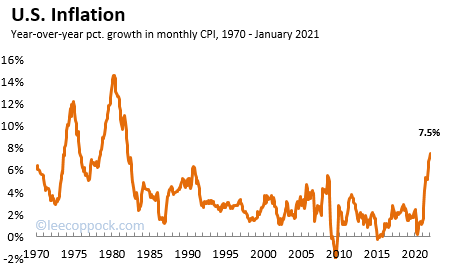
  • New CPI data released this week shows that, despite the claims and wishes of our government leaders, inflation is not going away anytime soon.  Inflation for the year ending in January is estimated at 7.5%, according to the BLS. As the graph below shows, this is the highest U.S. inflation rate in forty years.  
    Inf0222

    This is not good news.  Perhaps the most discouraging aspect is the reaction of many of our political leaders, who are blaming this inflation on supply chain issues and market power combined with corporate greed. On the one hand, yes, both of these are currently present and both can lead to higher prices. But while those issues might help explain a one time jump in the price level, there is no theory as to how they cause continued price level growth.  Overall supply chain issues are certainly not continually worsening over the past 18 months.  Similarly, corporate greed is not a new phenomenon that suddenly appeared two years ago and is now growing month by month.

    Here is an idea – maybe just maybe inflation is caused by changes in the money supply. The graph below shows the U.S. M2 money supply since 2010.  Clearly there is a fairly constant growth rate right up until 2020, when the slope of the line steepens drastically.  That is, M2 didn't just jump at the beginning of the COVID era, the rate of growth increased (the slope of the line) and never returned to the previous level.  In fact, M2 has increased by 40% since the beginning of 2020.  

    M2 2022

    Granted, M2 is an imperfect measure of our modern money supply. That said, changes in M2 of this magnitude are not irrelevant and changes in M2 can be used as a proxy for changes in the overall level of money in an economy.

    Finally, some economists might argue that the new money growth is completely appropriate or necessary in this era of instability and uncertainty.  Fine, but let's recognize and communicate this clear cause of the highest inflation rate we've had since 1982.

  • Omicron was supposed to derail the economic recovery but January employment data suggest otherwise.  The Employment Situation Summary, affectionately known as "The Jobs Report," for January estimates job gains of 567,000 in January, far exceeding expectations.  The graph below shows nonfarm employment since January 2012.

    Employ0222

    As a benchmark, a good month of labor market growth is about 200,000 new jobs a month.  Economists were worried that January might come in at less than 200,000.  However, even with this strong growth, total jobs in the U.S. are still well below the pre-COVID peak of  152.5 million in February 2020.

    The labor force participation rate (LFPR) also increased in January – up to 62.2% from 61.9%. And while this also remains well below the pre-COVID highs (see graph below), it is certainly good to see more people entering the labor force. 

    Lfpr0222

    Finally, the unemployment rate (graphed below) actually ticked up slightly to 4.0% in January. 

    Unemp0222

    Students often wonder how the unemployment rate can rise when many new jobs are added. In January, this happened because the total labor force grew by 1.4 million. This is not bad news, since many workers are now re-entering the labor force.  Hundreds of thousands found work, but some did not, and so the unemployment rate rose. Even with this increase, the unemployment rate is near previous low levels. 

  • Real GDP grew at a robust 6.9% in the fourth quarter of 2021, according to the advance estimate from the BEA.  Combined with growth from the first three quarters, this means 5.7% for the entire year 2021. The graph below shows that real GDP is now almost all the way back to its pre-COVID path.

    GPD2021.IV

    This data indicates a very strong year of growth for real GDP in historical terms.  But, of course, 2021 was not a normal year.  Coming on the heals of shutdowns in 2020, there was a lot of ground to be made up. Still, with unemployment now below 4% and real GDP growth at almost 7%, it seems like the economy was humming along nicely at the end of 2021.  That is, just before the Omicron variant of COVID-19 really spread at the very end of the year.  It will be interesting to see how growth in the first quarter of 2022 is affected by Omicron.  We can certainly hope that the effects are temporary.

  • The new CPI data released today by the BLS shows what many of us are feeling when we buy gasoline and groceries: inflation is here and it is not going away immediately.  The year-over-year measure was up to 7% in December 2012 and this is the highest level since June 1982.  The graphic below shows annual inflation since 2000.

    Inflation 0122

    The table below, from the BLS report, shows increases in the major category areas.  Year-over-year increases are shown in the last column.

    CPI categories 0122

    Over the course of the year, you can see that gasoline prices rose 49.6% and Used cars and truck prices rose by 37.3 percent.  But even grocery prices (food at home) rose by 6.5 percent.  

    This inflation won't go away anytime soon.  Even if prices don't rise at all for six months, the inflation rate will be over 4% in June because of the way this statistic is computed (using all data from the previous 12 months).  Unfortunately, prices are probably going to continue to rise throughout this spring.  


  • Today's jobs report from the BLS is a dose of much-needed good news.  The unemployment rate dropped again to 4.6 percent.  More importantly, 531,000 new jobs were added (to nonfarm employment).  The graph below shows monthly growth in nonfarm employment in this calendar year.

    Employ1021

    After robust growth in the summer months, fewer jobs were added in August and September. All of this is closely linked to the spread of COVID, as the Delta variant spread rapidly in August and September, before slowing in October.  

    Let's hope that today's announcement regarding the Pfizer COVID-19 pill will lead to even more economic progress over the coming months. 

  • Real GDP grew at just 2% in the third quarter, after consecutive quarters of more than 6% growth.  New data released from the BEA confirms that the Delta variant of COVID-19 significantly slowed the return to normal economic growth.  The Figure below compares real GDP with a trend line based on growth since 2010.

    GPD2021.III

    As a recap, shutdowns in early 2020 led to a 5% drop in the first quarter and then a 31% drop in the second quarter.  Then, as many businesses adapted, the recovery began with a whopping 33.8% growth of real GDP in the third quarter.  The first two quarters of 2021 yielded 6.3 and 6.7 percent growth as vaccine availability expanded.  But the Delta variant clearly slowed the progress back toward trend, leading to just 2% real GDP growth in the most recent quarter.

    Like everyone else, economists are hopeful that the recent decline in COVID-19 cases will help return us to pre-pandemic economic conditions, but 2% growth will not accomplish that.

  • The latest jobs report from the BLS is one of those weird times when the unemployment rate falls even while the overall report is not positive.  All of this stems from this strange and uneven recovery from the COVID-19 recession in 2020.  

    Let's start with the good.  The graph below shows the unemployment rate over the past 5 years.  The latest data shows a 0.4% drop to just 4.8% in September.  Normally, this would be heralded as great news.

    Unemp1021

    Now, let's look at jobs growth by graphing total nonfarm employment.  In September, nonfarm employment rose by 194,000.  This would often be considered solid growth.  But right now, we are recovering from a drastic drop in overall employment.  Given the plunge in total jobs in 2020, this level of growth is just not enough to get us back to a healthy level of jobs anytime soon.  In the graph below, you can see that jobs growth is slowing and that we still have 5 million jobs to add before we are back to the pre-pandemic level of employment.

    Employ1021

    Students might wonder how such a significant drop in the unemployment rate can be viewed as anything but great news.  It can help to show the labor force participation rate (LFPR).  In September, the LFPR actually fell, from 61.7% to 61.6% (see graph below).  This is especially concerning as we are recovering from the huge drop in employment and firms are struggling to find workers. 

    Lfpr1021

    It's always good for the unemployment rate to drop 0.4 percentage points.  This means that people who are actively looking for work are having an easier time securing a new job.  But it is hard to rejoice in this economy right now with so many sitting on the sidelines and employers having difficulty luring them into the labor market.  It will be interesting to follow these trends over the next few months.