• Folks, the economy may be slowing, but we are now actually working on the longest U.S. economic expansion on record.  It has literally been a decade since the last recession.  To be fair, the effects of that recession (the "Great Recession") lingered long after it was officially over.  But strictly speaking, the last recession finished in June 2009.  Prior to this current expansion, the longest on record was March 1991 to March 2001, so we are just now edging out that previous record (assuming we don't go into a recession this month!).

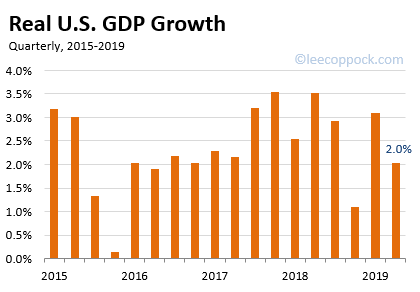
    The newest data release from the Bureau of Economic Analysis estimates real GDP growth for the second quarter of 2019 at just 2.0 percent, which is not great.  But the economy is still growing.  And don't forget the unemployment rate is still at historically very low level of just 3.7 percent.  

    That said, many economists are starting to worry about a possible recession on the horizon.  The figure below shows two sub-par (less that 3%) growth quarters in the past three.

    GPD2019.IIb

    Economists blame the escalating trade war with China (and others) for the slowing economy.

    But let's not end on that negative note: this U.S. economic expansion is the longest on record.


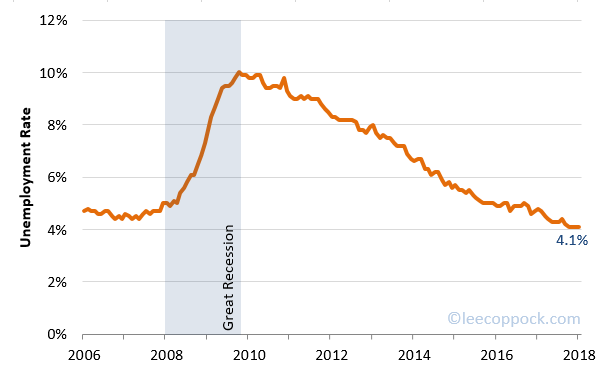
  • This morning, the Bureau of Labor Statistics released the Employment Situation Report for March. After the huge increase in nonfarm payroll employment in February (+326K), the economy added only 103,000 jobs this past month. Despite that, the unemployment rate remained at 4.1% for the sixth straight month.

    Unemployment3-18

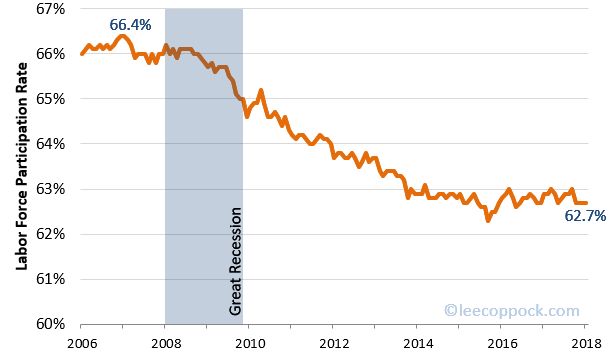
    Despite the apparently tight labor market, there is still room for growth. The labor force participation rate is still historically low at just 62.9%.  A decade ago, in March 2008, the labor force participation rate was 66.1 percent.


  • The Bureau of Labor Statistics released the Employment Situation Report this morning, as they generally do on the first Friday of the month. Throughout this semester, we follow at these reports and look closely at the number of jobs added, the unemployment rate and the labor force participation rate. In the month of January, the BLS estimates that 200,000 jobs were added, making it the 88th consecutive month of positive job growth and resulting in an unchanged unemployment rate of 4.1%. It is the fourth consecutive month that the unemployment rate is at 4.1%.

    Unemp0118

    The labor force participation rate remained at 62.7% for the fourth consecutive month (see below).  This is low by historical standards and has not increased as the economy gained steam over the past five years. This worries many economists as it seems that potentially available workers are not currently a part of the labor force.

    Lfpr0218

    The big number in this month's report is the average hourly earnings for private-sector workers which increased 0.34% this month, bringing the annual growth rate to 2.9%, the largest annual increase since 2009. This could be a sign that the tight labor market is finally making enough pressure to bring wages up. 

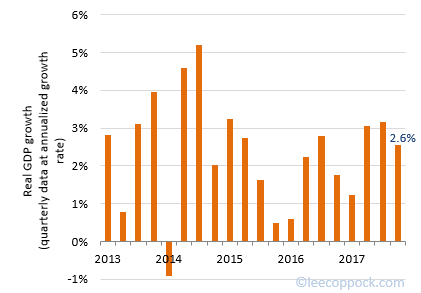
  • This morning, the BEA released the GDP estimates for last year.  The headline figure is the advance estimate of GDP for the fourth quarter of 2017. Real GDP, inflation, unemployment and the labor force participation rate will be the main statistics that we will follow this semester. After taking into account two strong quarters and historically low unemployment rate, at 2.6%, real GDP growth seems underwhelming. But let's not jump into premature conclusions.

    GPD2017.IV

    We can look more closely at the different components of GDP to better understand why the last quarter was actually pretty strong.  GDP is divided between spending on consumption (C), Investment (I), government spending (G), and net exports (NX).  Consumption increased by 3.8%, investment by 3.6%, government consumption expenditures and investment by 3.0%, exports by 3.9 percent.  What limited overall GDP growth is a 13.9% increase in imports.  This increase in imports is not harmful to the U.S. economy (we get more goods and services!).  But imports enter negatively in the National Income Accounts and so they reduce the estimate of GDP growth.  It is a little ironic that imports increased so much, given the Trump administration’s protectionist rhetoric.  In fact, this represents the largest import growth since the third quarter of 2010.

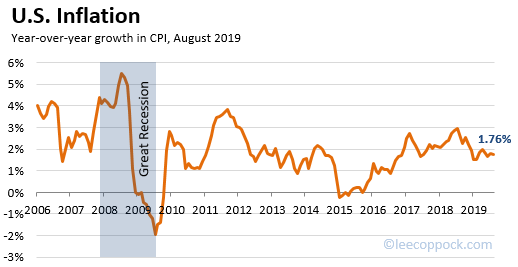
  • Earlier this week, the BLS released the Consumer Price Index Report for this past month. The CPI grew at just 0.1 percent in October and 2.05% over the past 12 months.

    InflationChart11-17

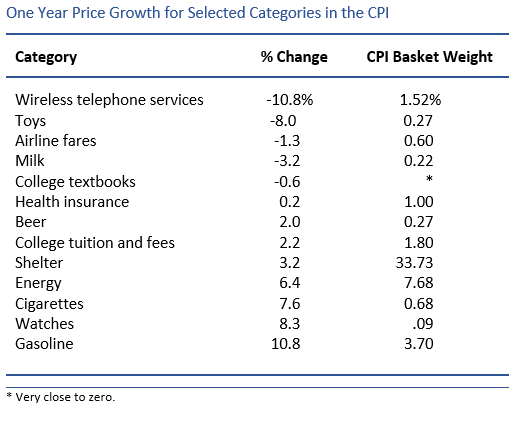
    The low overall inflation was accompanied by a 3.2% increase in shelter and a sharp 6.4% increase in energy prices. Together, shelter and energy amount to over 40% of the CPI basket weight that the BLS uses. The spike in energy prices is due to the 10.8 percent rise in energy commodities which is constituted by fuel oil and motor fuel. Since last October, gasoline prices have increased 10.8% and 39% since February of 2016.

    The table below shows October price changes in different CPI categories.

    InflationTable11-17

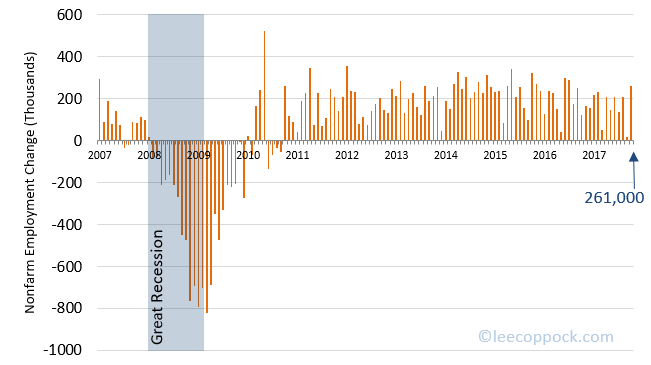
  • According to the Employment Situation Report released by the BLS this morning, unemployment for the month of October was at 4.1%, the lowest since December 2000.

    PayrollEmployment11-17

    The good news was accompanied by revisions in the number of payroll employees for the past two months which means that the US has had positive job gains for every month since October 2010.

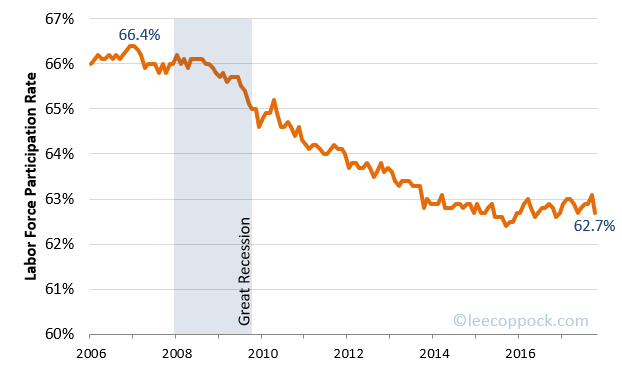
    On a less positive note, 765,000 people left the labor force this month which caused the labor force participation rate to dip 0.4 percentage points to 62.7%.  We will continue to monitor this measure.

    LFPR11-17

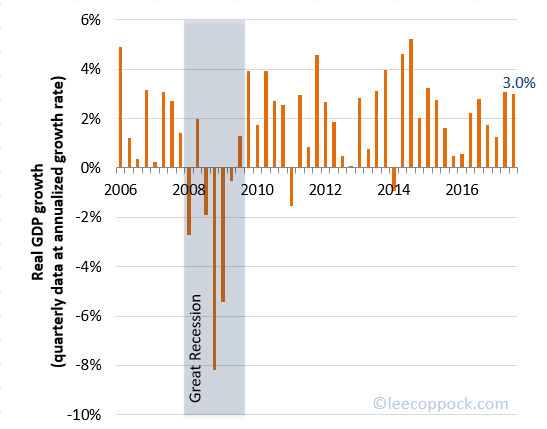
  • For the first time since 2014, real GDP in the U.S. grew at 3% or better for two consecutive quarters.  This is based on the advanced estimate for real GDP growth for the third quarter of 2017 released today by the BEA. This is a positive sign especially considering that real GDP per capita since the end of the Great Recession had only been growing at a slow 2.1%.

    GDPGQ32017

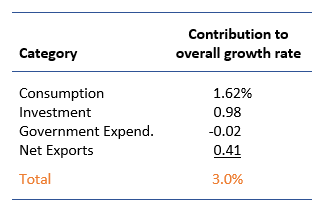
    Unlike the last quarter, where growth was mainly driven by a spike in personal consumption, this quarter showed a much more leveled growth across the different factors that comprise GDP. One change worth mentioning is that for the third time since 2014, there has been a decrease in imports which may be result of a weakening dollar.

    GDPTable2017.III

  • Consumer prices in the U.S. rose 2.2% over the past year, according to the latest Consumer Price Index (CPI) data released today by the BLS.  While inflation hovered around 1% for much of 2016, 2% seems to be the new normal in 2017. 

    InflationTable10-17

    The CPI was up 0.5% in September alone, with about half of this due to the 13.1% increase in gas prices.  We spend a lot on gasoline (about one out of every thirty dollars for the typical consumer).  Hurricanes Harvey and Irma are certainly to blame for much of the rise in gas prices because they caused the closure of many refineries.   

    The table below offers some examples of goods or services with price increases and decreases in September.

    CPI Table 1017


  • The U.S. unemployment rate fell to just 4.2% in September, the lowest rate since 2001, according to the latest Employment Situation summary published by the BLS today.  Additionally, the labor force participation rate increased to 63.1%. The highest level since March 2014. Even though the labor participation rate is still 3 percentage points lower than before the Great Recession, its steady numbers coupled with low unemployment rate, suggests that the US might be operating near full employment.

    LFPR10-17

    On the other hand, the seven year streak of positive job gains ended, at least temporarily, as the BLS reports 33,000 fewer jobs in September.  Probably, the main causes are Hurricanes Harvey and Irma. In the first week of September, when Hurricane Harvey hit, jobless claims spiked from 62,00 to 298,000.

    Capture


  • This morning the BLS released its monthly Employment Situation Summary, the first jobs report of this academic year.  These reports are released on the first Friday of each month and they report U.S. labor market data for the previous month.  During this year, we will follow monitor at least three data series from these reports.  The first is the national unemployment rate, shown in the graph below.  The graph goes back to 2006 which is prior to the Great Recession.  Unemployment peaked in October 2009 at 10% but is now down to just 4.4 percent.

    Unemployment9-17

    We will also watch to see how many new net jobs are created each month.  For this, we watch the series called Total Nonfarm Employment.  In August of this year, Nonfarm employment grew by 156,000 jobs.  That is a lot of jobs, but not necessarily in comparison to more than 153 million total nonfarm jobs in the U.S. economy.  In fact, this increase is below the average over the past five years (see graph below) of more than 200,000 per month. 

    Employ0817

    Finally, we will often report the labor force participation rate (LFPR).  This is the portion of the working age (non-institutionalized civilian) population that is either working or actively looking for work.  It has become important recently, as more workers are retiring and opting to stay out of the labor force for other reasons.  The graph below shows LFPR data since 2006.

     LFPR9-17

    You can see that the LFPR has been hovering below 63% for almost four years.  This is very low by historical standards and you can see that it was 66.4% back in January of 2007.  This difference represents millions of workers that are now out of the labor force.