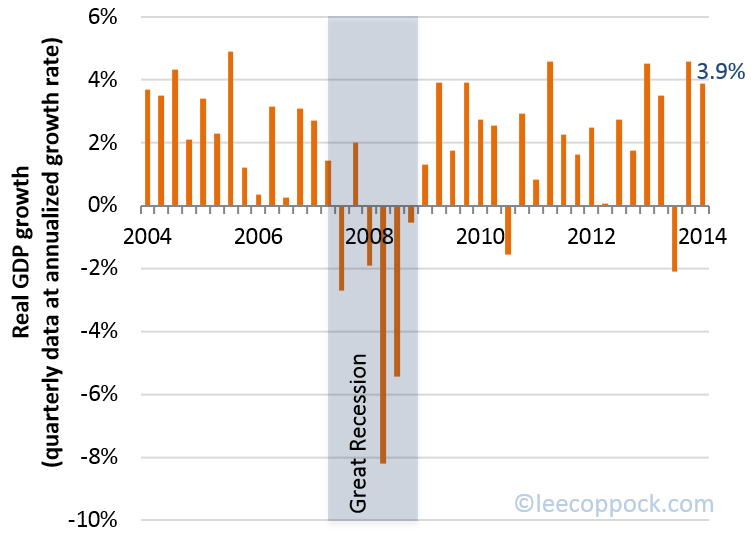
• Real GDP grew at a mediocre 2.6% in the fourth quarter of 2014, according to the latest release from the BEA.   Keep in mind, this is the first estimate of real output for last quarter and subsequent revisions have been significant recently.  However, if this estimate holds up, it means that 2014 ended on a relatively weak note, after two very promising quarters.  The graph below shows quarterly real GDP growth for 2013 and 2014:

    GPDShort2014.IV

    As the figure shows, 2014 was a mixed bag – with 2.4% growth for the calendar year.  The first quarter brought negative growth, probably supply and weather-related.  The second and third quarters both brought strong growth, but then that seems to have tapered off by the end of the year.  This followed just 2.2% growth in 2013.

    But the long run picture certainly looks better than just a few years ago.  We now have five consecutive years of positive annual growth.  This graph shows the path of real GDP over the past fifty years:

    GDPLR2014

    Growth over the past five years hasn't been explosive, at just 2.2% (versus 3% over the last fifty years), but the expansion period since the Great Recession, which ended in June 2009, is now over five years.

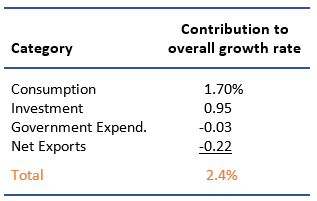
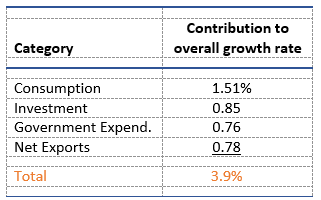
    Finally, we can look at the contribution to growth from the four components of GDP in 2014:

    GDPTable2014

    Over the course of the year, consumption contributed the most to growth but investment was also up.  Expenditures by all levels of government in 2014 were essentially flat, and net exports fell slightly (imports increased more than exports).

    The next GDP update is scheduled for February 27.

  • Last week, the BLS released the Consumer Price Index (CPI) for December 2014. Overall, the CPI dropped 0.4 percent in December, largely driven by the 9.4% drop in gasoline prices. Core CPI, which excludes food and energy prices was flat during December.

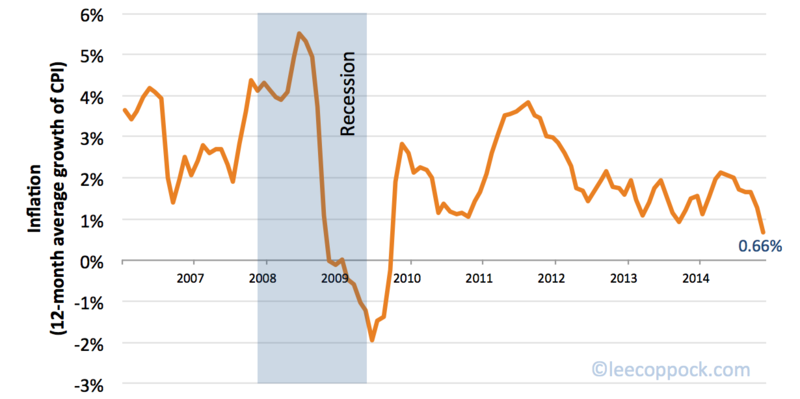
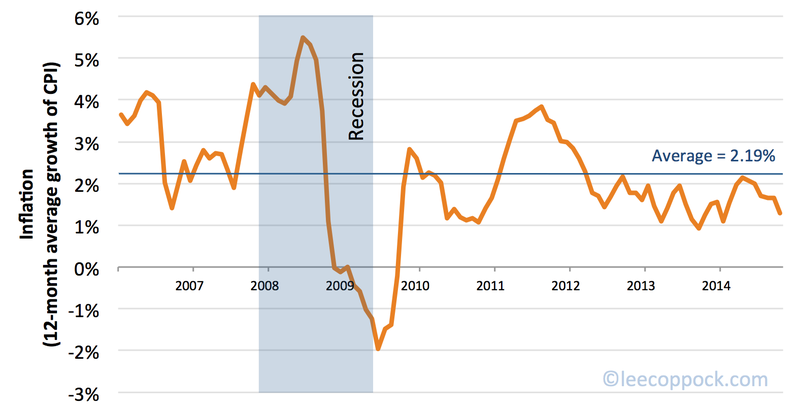
    The graph below shows one year growth rates in the seasonally adjusted CPI series.  Over the last twelve months the CPI increased just 0.66 percent, down from 1.23% the month before.

    Screen Shot 2015-01-16 at 8.42.13 AM


    The large decline is still mainly due to decreasing energy prices, including gasoline and oil. The energy index fell by 10.6 percent in the past year. Perhaps cold weather could stem this decline by increasing the demand for energy.

    But while gas prices are falling, food prices are moving in the opposite direction. Food prices climbed by 3.4% last year, their largest annual increase in three years.

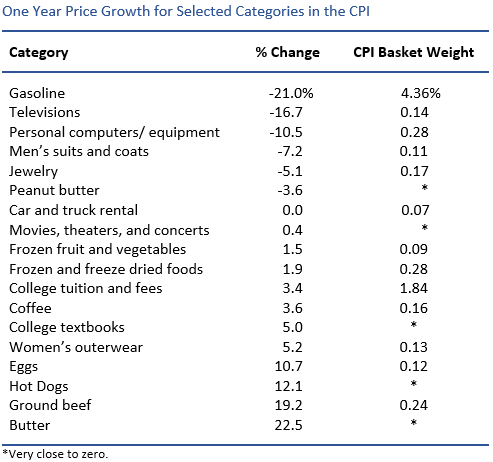
    The table below shows the price change for selected goods and services in the past twelve months:

    CPI Table 1214

    Notice:

    • Maybe you should buy your butter now.  The price of butter is still climbing quickly, rising "only" 22.5% in December, down from the 29.8% increase in October.
    • Textbook prices rose at 5 percent.  So that what a student could get for $150 last year, now costs $157.5.  Perhaps the new textbooks are better than the old ones.
    • The price change of hot dogs doubled. In November the increase was only at 6.0%, but in December, it was 12.1 percent.
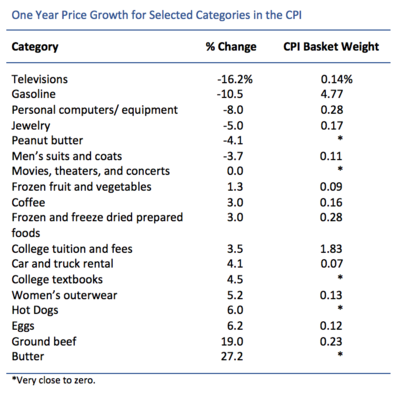
  • Gasoline prices dropped another 6.6% in November, bringing the year-over-year decline to 10.5 percent.  And since the average U.S. consumer spends almost five percent of their budget on gasoline alone, the price drop helped pull the overall consumer price index (CPI) down by 0.3% in November. 
     
    In the past year, inflation, as measured by growth in the the CPI, has been just 1.3%.

    Screen Shot 2014-12-17 at 8.42.30 AM

    We can dig further into the price report to see changes in prices of particular goods.  For example, the price of cookies increased by 1.8% in November. However, the price of flour and prepared flour mixes declined by 2.7%, so you might consider baking your own cookies.

    As usual, I also give you a few selected goods that have had both significant price rises and significant price falls (in the table below).

    Inflation 12-17-14

    According to the Energy Information Administration, the national average gas price is now at its lowest level since December 2008.  That certainly makes it cheaper to drive home for the holidays.


  • In September,  Eurostat waved a magic wand and increased the GDP in the European Union by 3.53 percent overnight. That is a full year's worth of very solid growth.  But it didn't make Europeans any wealthier because it was actually just due to a new definition of the way GDP is counted.  Eurostat (the economic statistics office of the European Commission) redefined GDP to include many transactions that were previously uncounted and are actually illegal across much of the Eurozone.
     
    The new GDP definition includes illegal drug deals, prostitution, and even sales of stolen goods. Specifically, it includes illegal transactions as long as both parties agree to the transaction.
     
    European-cannabis-lawsOstensibly, Eurostat is trying to capture part of the shadow economy that is typically not measured in GDP.  This makes sense, right? GDP is supposed to measure the output of final goods and services, so shouldn't we include all final goods and services even if the service is illegal?  In addition, this is complicated when the legality of goods and services varies across nations.  For example, the map to the right (from Wikimedia Commons) shows how cannabis laws vary across Europe – cannabis is essentially legal in some nations like the Netherlands but strictly illegal in others like France. 
     
    So, normalizing the accounting standards across nations makes sense. But these illegal activities are difficult to measure.  In addition, if the illegal activities are a relatively stable portion of GDP, then there is really no bias when they are not included.  In fact, the new estimates, in an attempt to provide a more complete measure, may actually introduce more error into GDP measurement due to the difficulty of estimating illegal trade.  
     
    So why the change in definition? There is another, perhaps insincere rationale: the new GDP measurements are a bit of an accounting trick to help nations lower their deficit to GDP ratios.  Many European nations are dealing with high deficit (and debt) to GDP ratios. The European Commission has explicit rules regarding these budget measures: a nation's deficit in a given fiscal year is not to exceed 3% of  their GDP, and the national debt is not to exceed 60% of GDP.  When nations exceed these bounds, the Council is directed to bring coercive measures called Excessive Deficit Procedures (EDRs). The Council has certainly been lax in enforcing these EDRs in recent years.  However, increasing GDP by simply redefining how it is measured automatically lowers deficit and debt ratios and helps nations with higher government debt levels. 
     
    The figure below shows the effect of the new GDP definition on the GDP level each nation in 2013 (along with the overall EU and Euroarea).  The countries are ordered according to their GDP gains from the ESA 2010.
     
    GDP percentage change ESA 10 mac
     
    As you can see, GDP for Cyprus jumped 9.8% exclusively due to this accounting change.  This re-definition of GDP then shrank the debt-to-GDP ratio in Cyprus by a full half of a percentage point in 2013 – reducing it from 5.4% to 4.9%.  Therefore, this accounting rule change exaggerates any debt reduction in Cyprus, as they (hopefully) move closer to the EU goal of 3 percent.
     
    So while new GDP accounting rules in Europe may normalize national income accounting across the continent, they are particularly helpful to those nations that already have high government debt levels.
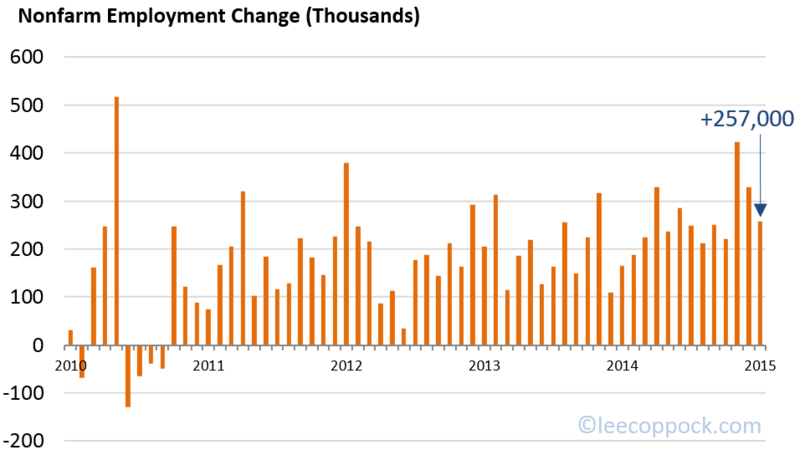
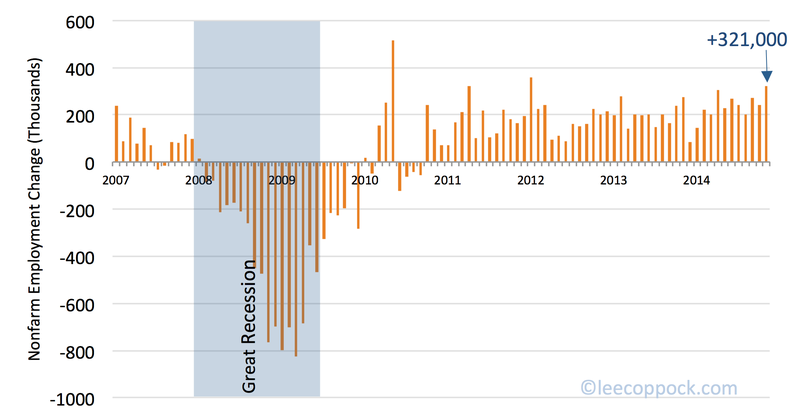
  • The U.S. economy added 321,000 new jobs in november, extending the streak of positive jobs growth to fifty straight months.  So far in 2014, nonfarm employment has grown by 2.65 million jobs or 221,000 jobs per month.

     Screen Shot 2014-12-05 at 12.26.15 PM

    As they are studying for finals, students might like to know which subjects relate to industries that have recently experienced significant jobs growth.  For example, 86,000 jobs were added in professional and business services in November alone, while the previous 12 month average was 57,000 jobs per month. Digging further, there were 16,000 in accounting and bookkeeping alone. So any students struggling to find incentives to study for accounting exams need just consider the job prospects waiting for them.  Another career path to consider might be health care, which added 37,200 jobs in November.

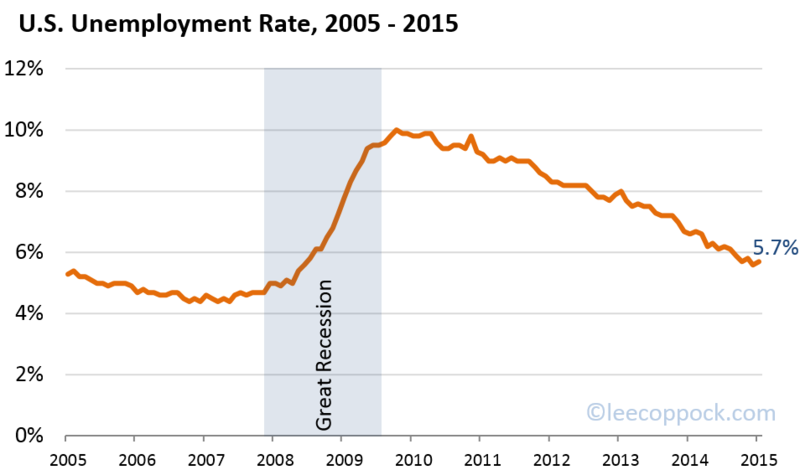
    Unfortunately, all this jobs growth did not reduce the unemployment rate, which remained steady at 5.8 percent.

    Screen Shot 2014-12-05 at 12.08.37 PM


  • With today's GDP data release, the BEA increased their estimate of real GDP growth in the third quarter today to 3.9 percent (up from th earlier estimate of 3.5%). This, combined with the 4.6% growth from the second quarter, means the U.S. economy experienced solid and above normal growth through the middle of 2014. 

    GPD2014.IIIB

    The revisions in the new release, based on more complete data, include upward revisions in both consumption and investment.  The contributions to overall growth from each of the four major components of GDP are presented in the table below:

    GDPTable2014.IIIb
     

    You can download the data here.

  • Inflation seems to be firmly in check, according to the October CPI News Release from the Bureau of Labor Statistics.  Overall, the CPI was flat in October and up just 1.7% in the past year. 

    Screen Shot 2014-11-20 at 8.44.45 AM

    Even though the overall price level has been relatively stable over the past year, there have been several wild swings in individual prices – some positive and some negative.  For example:

    • Even though gas prices are declining, that doesn’t mean that electricity bills are too. Electricity prices climbed 3.1% in the past year while gas prices fell 5% over the same period.
    • Not all protein is the same: The price for chicken remained constant within the past twelve month, while egg increased by 6.7%, and ground beef by 18.6%.
    • Comparing prices of apples and oranges? It’s possible but it shows they are different. Apple prices decreased by 0.5% while orange prices increased by 9.6%.
    • Booking airline tickets in advance doesn’t always have to be cheaper. The price index for airline fares declined by 2.08% within the past year.
    • The omnipresence of streaming services like Netflix might explain why the price for DVDs decreased by 8.5% in the past year. Interestingly though their price increased by 2% in the past month.

    The table below offers examples of price changes over the past year from big price drops to big price rises.

     CPI Table 1014
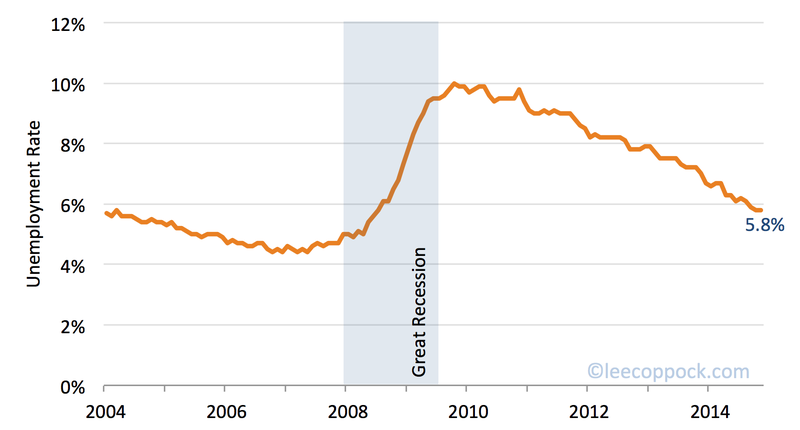
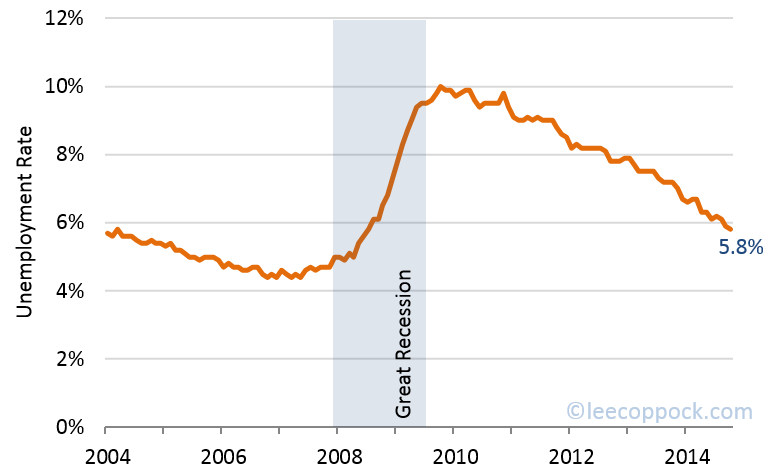
  • This morning, the BLS released the Employment Situation report for October and the news is very good.  The unemployment rate is now back to 5.8% for the first time since July 2008. 

    Unemp1014

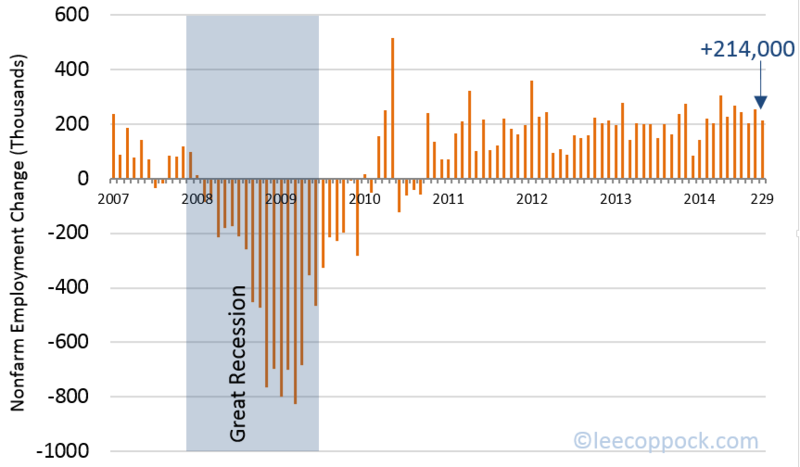
    In addition, there were 214,000 new jobs added in October.  The economy has added more thatn 200,000 jobs per month for nine straight months now.  In 2014, we are averaging 229,000 new jobs per month.  That is real recovery.

    Employ1014


  •  Real GDP grew 3.5% in the third quarter, according to the advance estimate released by the BEA.

      GPD2014.IIIA

    A big piece of the growth came from net exports (exports minus imports).  Exports rose by 7.8% and imports fell by 2.4%.  Since net exports makes up a very small piece of total GDP, this contributed 1.3% to real GDP growth, but this is more than a third of the total growth in the third quarter.

    Here is  a complete breakdown in the growth contribution from each of the four major components:

    GDPTable2014.III

    Overall, 3.5% is a solid growth rate, assuming this estimate holds up through revisions over the next three months.  However, it is slower that the growth experienced in the second quarter, which was 4.6 percent.  One big difference between the last two quarters is in investment which contributed just 0.2% to third quarter growth but contributed 2.9% in the second quarter.

  • The overall consumer price index increased by 1.7% over the 12 months ending in September.  For September only, prices rose by just 0.1 percent. Interestingly, the same increases are true when food and energy price changes are excluded from the calculation.
     
    Inflation0914
     
    But even though overall prices rose by 1.7% over the past year, some categories rose much more and some categories even fell.  The table below summarizes some of the categories where prices changed significantly over the past year, along with some categories that tend to be important to college students.  The third column in the table shows the relative weight assigned to the given category in the calculation of the CPI.  This value indicates the portion of a typical consumer's monthly expenditures allocated to that category.
     
    CPI Table 0914
     
    Notice how:
    • Ground beef prices rose 17.2% in the past year.  No wonder so many are turning into vegetarians.
    • Gasoline prices continue to fall, dropping 3.6% in the past year.  I mentioned this on Twitter last week, citing a Wall Street Journal article.
    • Textbook prices rose 5.1% and college tuition and fees are up 3.4%
    • Women's outerwear prices rose by 11.3% but men's suits and coats prices increased by just 2%