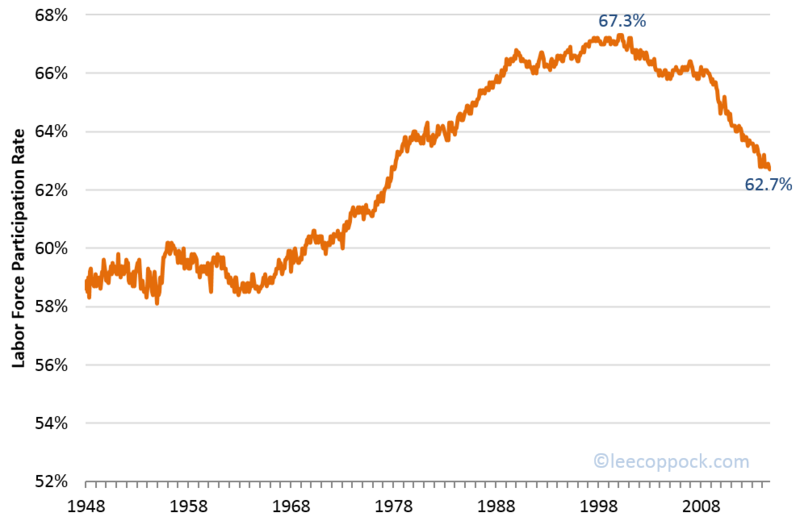
• I've blogged about this before (see here), but the labor force participation rate (LFPR) just keeps falling.  Nobody sees this as positive news – more and more U.S. workers are sitting on the sidelines.  The latest jobs report brought the good news of a falling unemployment rate, but part of this is because workers are leaving the labor force.  As the graph below shows, the overall LFPR in the U.S. is now down to 62.7 percent, which is the lowest it has been since many women entered the labor force in the 1960s and 70s.  

    LFPR
     
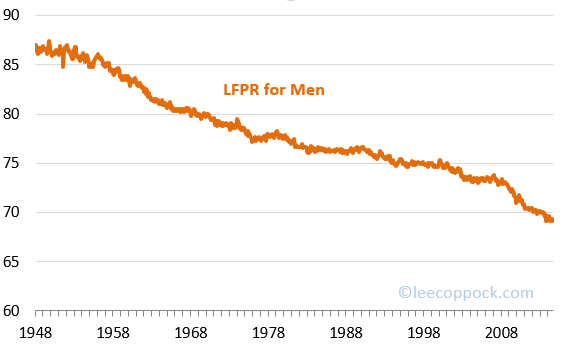
    One way to clarify the magnitude of this decline is to focus on the LFPR for men only.  This has steadily fallen from almost 90% in 1948 to just 69.1% currently (see the graph below).
     
    LFPRmen

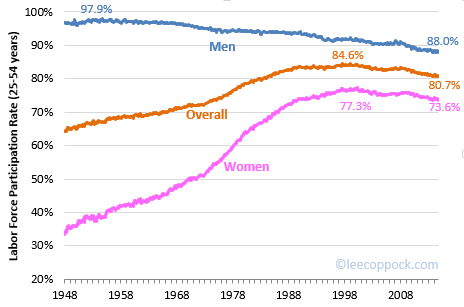
    Also, let's not conclude that this is all due to the aging of the baby boomers.  As Michael Strain recently noted in a series of tweets (here is one), the LFPR is declining even among those aged 25-54.  The LFPR for this age group is plotted below.

     
    LFPRall
    All of this means that the economy is not as healthy as we would like and that part of the reason why the unemployment rate is dropping is that people continue to leave the labor force.
     
  • The unemployment rate dropped to 5.9 percent in September, the lowest level since July 2008.  The last time our unemployment rate was below 6 percent, the economy was in the free fall of the Great Recession.   

    Unemp1014

    The drop in unemployment was driven by strong jobs growth, with 248 thousand jobs added to nonfarm payrolls.  To understand just how strong this is, we can compare this to average job growth over the past five years, which was 154 thousand new jobs per month.

    Newjobs0914

    In addition to these new September jobs, there were revisions to earlier estimates of nonfarm employment: July was revised up by 31 thousand and August by 38 thousand jobs.

    Finally, students may be interested to know that employment in "food services and drinking places" increased by 20,000 in September and 290,000 over the past year.

  • The BEA now estimates that real GDP grew by 4.6% in the second quarter. This revision means that the most recent quarter saw the fastest real GDP growth since 2006. That's a long time.  Before we get too excited, let's remember that this comes on the heels of negative growth in the first quarter.
    Screen Shot 2014-09-26 at 4.31.06 PM

    The growth was driven largely by changes in investment, which grew by $115.5 billion, or 19.1 percent on an annual basis.

    Those who follow me on Twitter may recall that, back on July 3, I predicted that second quarter growth would come in at "something like 5 percent." My rationale was that the negative first quarter growth was likely due to short run supply factors associated with the polar vortex.  After all, the unemployment rate fell consistently throughout the spring.  Even a blind squirrel finds a nut once in a while.

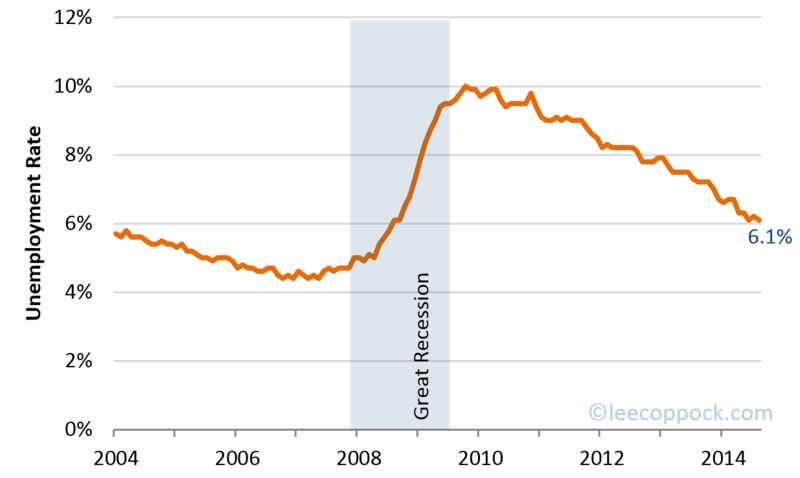
  • The unemployment rate for August ticked down to 6.1 percent, but this was not considered a great job report by most economists.

      Unemp0814

    The disappointing news is on the job growth side, with just 142,000 jobs added (see graph below).

    On the one hand, 142,000 NEW jobs can't be considered terrible news.  On the other hand, the big issue with the recovery from the Great Recession has been whether the economy can sustain jobs growth.  For comparison purposes, note that, since 2011 the U.S. economy has been averaging 190,000 new jobs per month.  So this recent news is not reassuring.  It will be interesting to follow total employment over the next few months.

      Employ0814

    Finally, the labor force participation rate remains at modern historically low levels.  For August, it was just 62.8%.  The LFPR has not been lower since February 1978.


  • The second estimate of real GDP growth from the BEA and it confirms a strong rate of 4.2 percent.

    GPD2014.II

    The strong second quarter reinforces my view that the first quarter contraction (-2.1%) was largely due to a short run supply shock.  It seems like a long time ago now, but you probably remember just how cold that polar vortex was.

    One last graphic.  This one is an update that shows how the path of real GDP is just not moving back to the long run trend prior to the Great Recession. 

    GPDtrend2014.II

    Something structural definitely happened during the Great Recession.  Aggregate demand declined, but long run aggregate supply must have too.

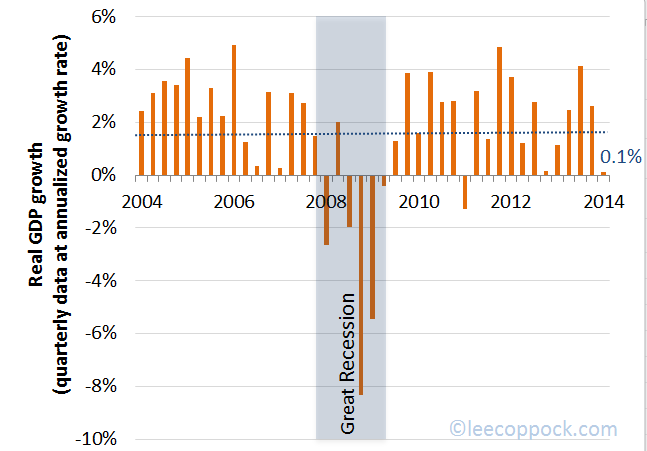
  • I'll post more on this later, but I wanted to point out that the new GDP report is available. It shows that the first quarter of 2014 was particularly weak, with growth of just 0.1%.

    GPD2014.I

    Remember, this is the first estimate and these have recently been adjusted upward.  Even so, nobody expected such a weak report.


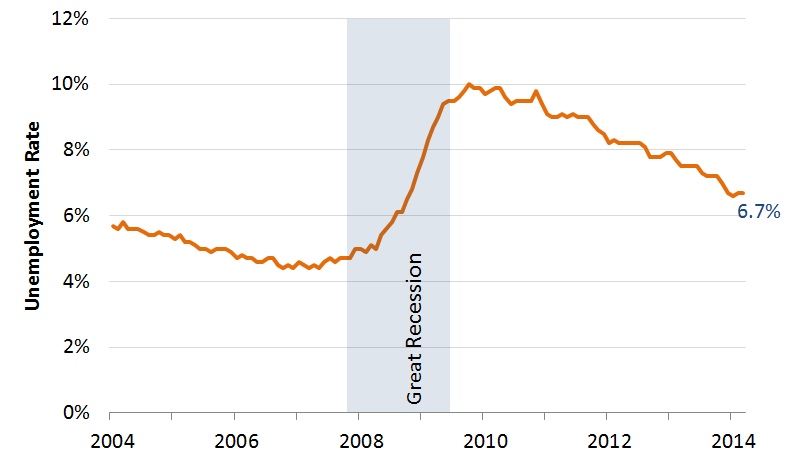
  • The BLS released the March jobs report today and I think the news is positive. Even though the unemployment rate did not fall, it did hold steady at 6.7%. 

    Unemp0314

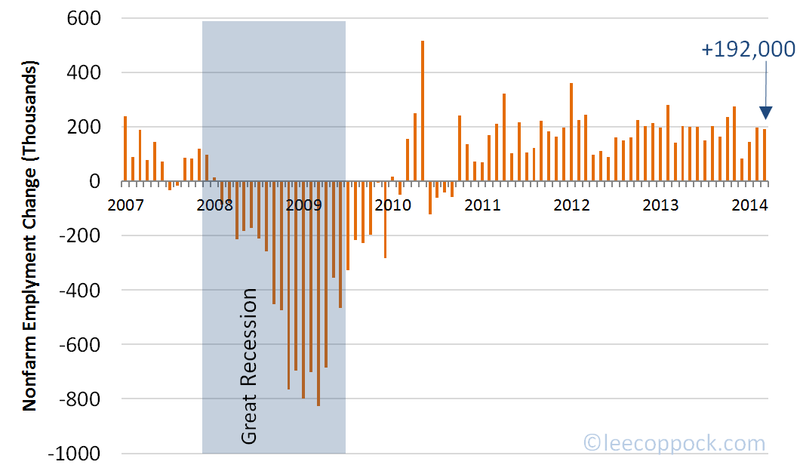
    I see two pieces of good news in this report.  First, 192,000 new jobs were created in March.  This, along with a total of 37,000 jobs added as revisions to estimates for January and February, means three solid months of jobs growth, averaging 178,000 new jobs over this period.

    Newjobs0314

    The second piece of good news is the (moderate) rise in the labor force participation rate, which is now up to 63.2% (up from 62.8% in December). 

    All in all, these are the kind of reports we need if the unemployment rate is going to fall back down to a reasonable, natural rate of around 5%.


  • Last Friday, the Fed released the detailed transcripts of FOMC meetings during 2008, the year they realized the gravity of the financial crisis.  It's a big job, but if you are so inclined, you can read the transcripts in their entirety here

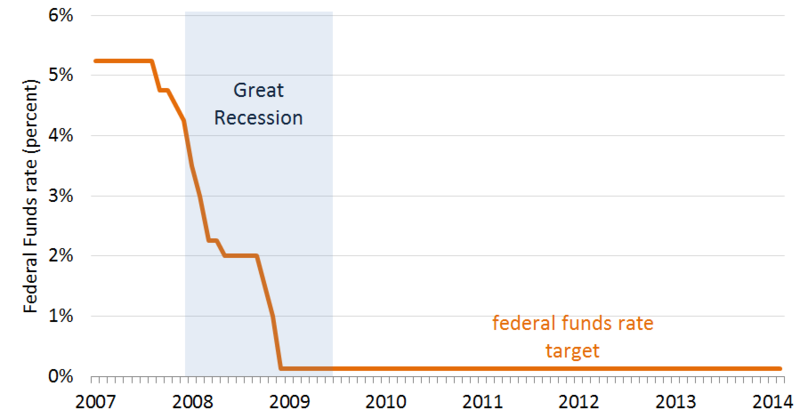
    The NY Times has done us all a service by splicing key statements by Ben Bernanke, Janet Yellen, Timothy Geithner and others, along with the key graphics that chronologically show how the Fed has responded to the crisis.  One graphic tracks the evolution of the Fed Funds target rate (shown below) during 2008, as it dropped the target from 4% to almost zero. 

    Fedfundsrate

    Janet Yellen was one of the first to sense the potential danger.  Here is a quote from January 21, 2008, in which she supports a historically large cut in the Federal Funds target rate:

    I strongly support your proposal for a 75 basis point funds rate cut today… The outlook has deteriorated, not only since December but since our conference call.  The downside risks have clearly increased.  I think the risk of a severe recession and credit crisis is unacceptably high…

    In hindsight, it is clear that Yellen was right on.


  • Today's jobs report brought mixed news.  On the one hand, 113,000 new jobs were added to the economy in January.  On the other hand, the unemployment rate continued its decline, falling to 6.6 percent.  For perspective, note that just one year ago the unemployment rate was 7.9 percent.

    Unemp0114

    One other piece of good news – the labor force participation rate rose slightly to 63 percent.  Perhaps this rate has stopped its decline.

    Lfpr0114

    In sum, the labor force grew while the unemployment rate declined.  We need more months like that.

  • Real GDP grew at 3.2% in the fourth quarter of 2013, according to the first estimate released by the BEA this week. This news is decidedly… not terrible.  You could spin it to be good news or just mediocre news.  But, assuming the estimate doesn't change much in subsequent revisions, we've now had two solid quarters of growth.

    The first graphic shows real GDP growth since 2003, by quarter.  Recession periods are shaded and the dashed line shows the long-run average of 3%.  For the year 2013, real GDP grew at 1.9%. Though this isn't too impressive, it's understandably driven by poor performance in the first quarter.

    GPD2013.IV

    The second graphic shows the long-run path of real GDP, going back 50 years.

    GDPLR2013

    Finally, we can zoom in on real GDP over the past twenty years along with a trend line.  This graphic clarifies the mediocre nature of growth in the wake of the Great Recession.  At some point, we hope that growth can restore GDP to the long-run trend line.  There just hasn't been any bounce coming out of that last recession.

    GDPgap2013

    Keep in mind, this is just the first estimate for 2013 GDP and subsequent revisions can be significant.